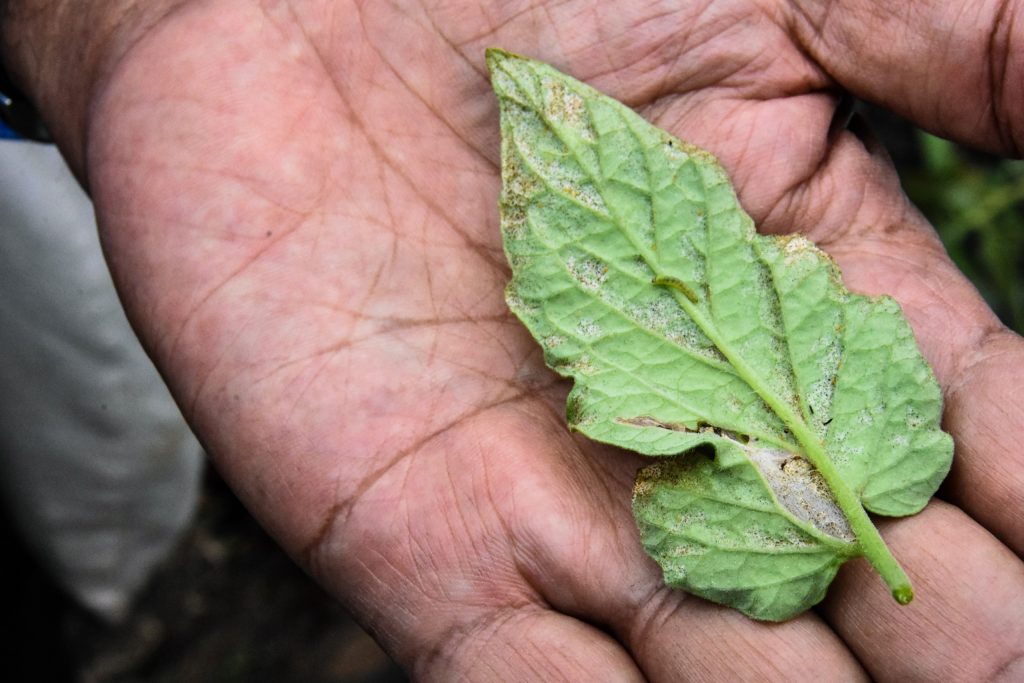
Virginia Tech entomologist Muni Muniappan has warned of Tuta absoluta’s likely arrival into the United States since he began monitoring the pest’s spread throughout Africa in 2012. Thanks to a joint grant from the U.S. Department of Agriculture, Muniappan’s team and collaborators will be able to model the pest’s entry into the United States — protecting the country’s billion-dollar tomato industry — before irreparable damage is caused.
Tuta absoluta is a tomato pest native to South America. If left unmitigated, it has the potential to destroy 100 percent of tomato crops. In 2016, the pest caused a “tomato emergency” in such countries as Nigeria, where tomatoes are a lifeline for many smallholder farmers. With the U.S. as one of the world’s leaders in tomato production, the pest’s impact would be severe if nothing is done to stop it.
The USDA’s Food and Agriculture Cyberinformatics Tools Initiative awarded the University of Virginia’s Biocomplexity Institute and Virginia Tech the four-year, $500,000 grant to project the pest’s movement and rate of spread into the U.S. The model, to be developed by the Biocomplexity Institute, will map the spread of invasive species over time, accounting for factors such as climate, biology, and demographic information.
Virginia Tech’s Feed the Future Innovation Lab for Integrated Pest Management laid the groundwork for the grant, having modeled the pest’s spread in South Asia and determined that tomato fruit and seedling shipments are how it spreads.
“The Tuta monitoring and modeling work we’ve done in the developing world has cultivated major value back to the United States,” said Muniappan, director of the IPM Innovation Lab. “Projecting the spread helps us determine targeted management options, which will contribute to reduced economic loss.”
There is no comprehensive eradication method for Tuta, so early detection is key to getting ahead of its scourge. With globalization on the rise, the spread of invasive species, and the subsequent loss of native species, is rampant.
Muniappan and the IPM Innovation Lab sounded the first alerts of Tuta reaching Senegal in 2012, which led the team to conduct numerous awareness and management workshops throughout both Africa and Asia. The program warns against reliance on pesticides to keep Tuta at bay, as the pest has developed resistance to many chemicals.
Before the pest reaches the U.S., the teams will have modeled where it is headed and how fast it will move. By that time, the collaborative teams will already have traps and additional ecological solutions in place to curb the spread and protect the vital tomato industry.
“Our model forecasted that if left unmitigated, Tuta will invade all major vegetable growing areas of mainland Southeast Asia within five to seven years,” said Abhijin Adiga, research assistant professor at the Biocomplexity Institute. “By predicting where in the U.S. the pest will reach first, we can similarly assess the capabilities of the area to combat the pest and intervene accordingly.”
The Feed the Future Innovation Lab for Integrated Pest Management is housed at the Center for International Research, Education, and Development, part of Outreach and International Affairs.
— Written by Sara Hendery