



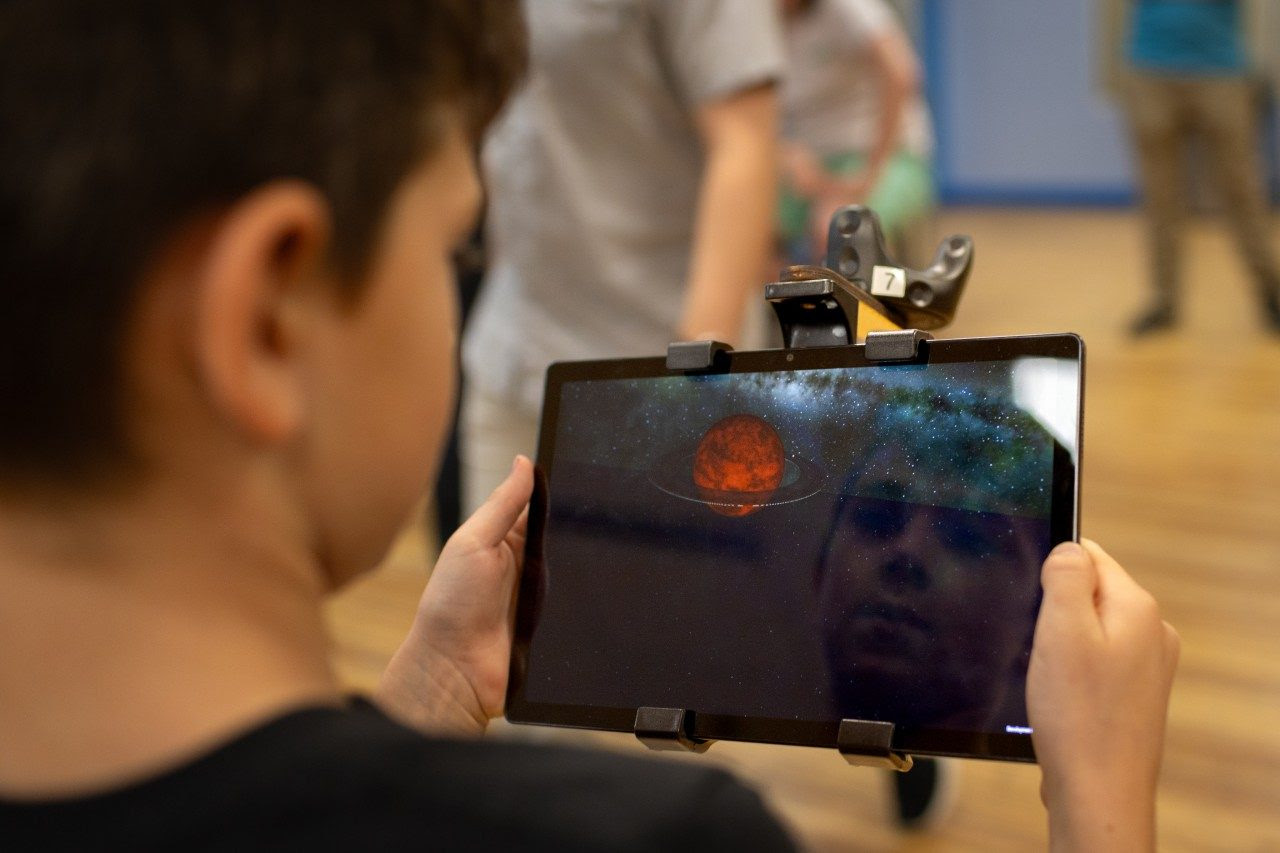
BLACKSBURG – Blast off into space and explore the solar system through a unique virtual experience that sends users into orbit. With support of a National Science Foundation grant, a team of developers in the Applied Research in Immersive Experiences and Simulations (ARIES) program in University Libraries is using virtual reality to develop an interactive universe.
In this experience, users become virtual astronauts and move through space to visit all of the celestial bodies in our solar system.
“The purpose of this program is to create a virtual reality experience for young learners to engage with STEM content that is inclusive and comfortable in a way that allows for socially constructed learning,” said Todd Ogle, executive director of ARIES.
A new method of exploration
Instead of using virtual reality headsets, this experience utilizes handheld tablets that serve as windows into the virtual space.
“When you’re wearing virtual reality goggles, you can’t engage directly with anyone else in the space with you. You can’t see them. You can’t talk directly to them in an easy or natural way. We wanted learners to be able to use normal social interaction as part of the learning experience,” Ogle said.
The virtual environment consists of a 30-by-30-foot space with four devices that track the location and orientation of tablet computers used by the students. Within this virtual environment, young learners can explore the solar system in pairs or solo, interacting with the content, the teacher, and one another while doing so.
Addressing misconceptions about space
The program’s developers created an immersive experience that accurately represents how the solar system functions. This means myth-busting some popular misconceptions.
“There are a lot of ideas that students have such as how big all of the planets are and how close they are to each other as well as how the moon phases truly work,” said Matthew Gallagher, computer engineering major and immersive developer on the project.
Users are virtually placed in the true-to-size solar system. When accurately presented, planets are impossible to see. The sun, which only takes up two pixels on the screen, is the only object visible to the human eye. To make sense of the black void, the developers placed arrows to point to where planets would be in their orbits.
After the actual scale is established, the celestial bodies are enlarged to a size more supportive of active learning. Users are then placed into different scenes, such as the phases of the moon or the mechanism behind the ocean tides, finally having an opportunity to build their own planet.
“The kids love the planet-builder feature. They get to pick different attributes like whether it’s a rocky planet or a gas giant, orbit velocity, and where it is placed in our solar system,” said computer science major and immersive developer Clara McDaniel.
Collaboration is key
The creation of the virtual solar system requires collaborative efforts across Virginia Tech and beyond: Sang Won Lee, principal investigator, computer science; Todd Ogle, co-principal investigator, University Libraries; Myounghoon Jeon, co-principal investigator, industrial and systems engineering; Phyllis Newbill, co-principal investigator, Institute for Creativity, Arts, and Technology; Chelsea Lyles, co-principal investigator, Student Affairs; and Katherine Brooks, director of operations, Science Museum of Western Virginia.
Working in collaboration with the principal investigators and under the supervision of Sarah Tucker, program coordinator for ARIES, a team of students from disciplines across the university developed the program, incorporating physics, instructional systems design, and art along the way: Matthew Gallagher, computer engineering, Class of 2025; Leah Ican, computer science, Class of 2025; Clara McDaniel, computer science, Class of 2025; Atlas Vernier ’23, industrial and systems engineering and French; Macey Cohn ’23, computer science; Shane Bennett, computer science, Class of 2025; Priyanka Nair ’23, computer science; Karina Springer, graphic design, Class of 2024; Alayna Ricard ’22, creative technologies; and Nayha Pochiraju ’22, creative technologies.
Every solar system needs a galaxy to call home
The virtual solar system is still in its developmental stages, but it is slated to be completed in the fall of 2024. Once finished, it will reside in the Science Museum of Western Virginia as an interactive exhibit.
Ann Brown for Virginia Tech


