Tom Ewing
Fifty years ago, the Bikecentennial brought thousands of cyclists to southwestern Virginia, including more than 20 miles in Montgomery County. A stated purpose of this unique observation of America’s 200th birthday in 1976 was to highlight historical sites along the route. The Bike 76 VA project at Virginia Tech builds upon and expands this original purpose by highlighting historical themes along the route that tell distinctive stories across more than 500 years of American history.
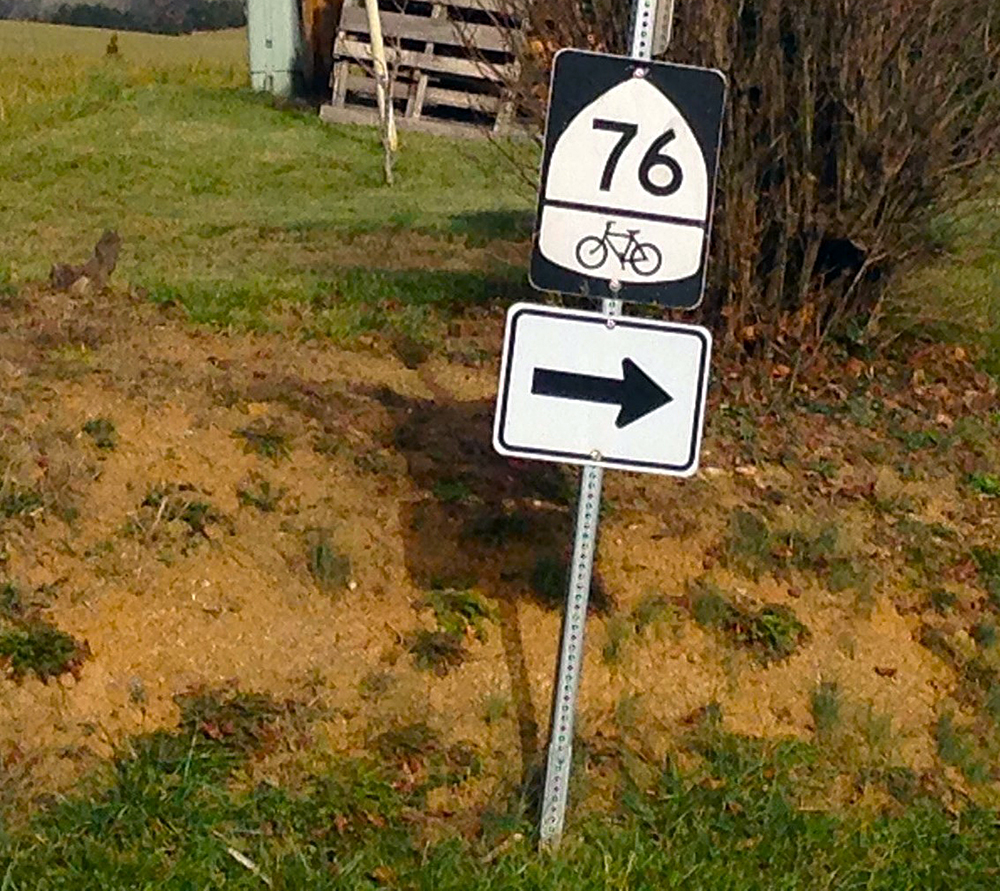
The intersection of Catawba Road (Route 785) and Lusters Gate Road (Route 723) just north of Blacksburg is one place along Route 76 where this history may be made visible to visitors as well as local residents. Westbound cyclists who begin in Yorktown reach this intersection after riding over the Blue Ridge and through Catawba Valley. Eastbound cyclists who begin in Oregon or at the Kentucky border ride from Radford to Christiansburg, past the Cambria railroad station, and down Depot Street into Ellett Valley. From either direction, the intersection is distinctive because it requires a sharp turn and thus attentive navigation.
The intersection is also distinctive because of a sign on a brick building at the intersection: “The Old Cheese Factory circa 1930.” The sign is mostly correct: a cheese factory did function in this vicinity during the 1930s. The cheese factory originated in the vision of William Dabney Saunders, an agricultural extension faculty member at Virginia Polytechnic Institute (VPI) who served as Secretary of Agriculture for Virginia for three years, beginning in 1908. As early as the 1910s, Saunders began advocating for Virginia dairy farmers to form cooperatives to produce cheese from their excess milk, especially when the price of milk fell below a profitable level.
In a Dec. 1, 1916 article in the Southern Planter, Saunders stated that a cheese factory can be “operated to advantage” with just one hundred cows. A farmer who took the “special course in cheese making” at VPI for just six weeks would have “no trouble” in “getting a factory started and making a good article of cheese from the beginning.” According to Saunders, “good cows” could produce 4000 pounds of milk each year, which would result in 400 pounds of cheese. At an estimated sale price of 25 cents per pound, a single cow could produce $100 in cheese sales each year. Beyond the immediate return, Saunders argued that ten years of “intelligent dairy farming” would increase the value of land due to the greater productivity of the herd. In 1917, Saunders met with farmers in the Roanoke and Catawba valleys to demonstrate production techniques and discuss setting up a cooperative factory, but it would take another decade to bring these efforts to fruition.
In 1930, Saunders met with regional farmers dealing with plummeting dairy prices in the first year of the Depression: “I suggested they try to sell milk in the form of cheese and the farmers decided to give it a try.” Saunders rented a building for $3 a month, acquired processing equipment, and began making cheese within a week: “It was a very crude and bold attempt, I guess, but the result was that the market price of milk in this area increased twice soon afterward.” About twenty farmers agreed to set up the Roanoke Valley Cheese Cooperative.
The cheese factory in Ellett Valley was one of the first of these efforts, which then spread across the state. In the 1930s, cheese factories provided farmers with access to markets during the Great Depression which posed reall challenges to the rural economy of the state.
For more than 30 years, the factory at Lusters Gate produced cheese from local farms. A 1947 article in the Montgomery News Messenger reported annual output of more than one hundred thousand pounds of cheese with milk contributed from more than eighty farms. The secretary of the cooperative, G. T. Grice, offered this assessment: “It’s small, but it has played a very important role in making dairying a profitable business.”
In a 1952 interview, Saunders offered this summary of the Luster’s Gate factory: “The cheese cooperative has been going strong ever since…We have a factory and a business worth $50,000 and we make about 1,200 pounds a day during the Summer and 400 pounds a day during the Winter.” Even at age 89, Saunders stated, “I’m still active as can be…and I keep in pretty close touch with the cheese factory. I still can tell them a lot of things.”
In the 1960s, the Roanoke Valley Cheese Cooperative managed the factory, with more than a hundred farms contributing dairy products. Cheese was sold at the factory, with customers ranging from local residents to football fans on their way to Blacksburg. By the end of the decade, however, changes in market demand, agricultural practices, and dairy regulations combined to erode the minimal returns available to farmers. By the time the Bikecentennial riders reached Ellett Valley in 1976, the Cheese Factory had ceased operations. The brick building was subsequently converted into apartments, which are still for rent at the same location.
This location has a longer history that connects the cheese factory to earlier communities across this region. Indigenous peoples used pathways through the valleys and along streams for hunting, trade, and migration. When European settlers displaced indigenous communities, they established farms that in some cases were still managed by descendents in the twentieth century. Valley roads (including the turnpike that produced the name, Lusters Gate) were mapped along the same walking trails used for centuries by indigenous peoples.
This intersection and the durable brick building persist as a meaningful landmark for cyclists. Westbound riders on the TransAmerican Route 76 should stop at this intersection to check maps or navigation devices – or else they will find themselves on an unplanned detour into Blacksburg with more than a mile of climbing. Eastbound riders on Route 76 should check their supply of water, because the next service station isn’t until Daleville, almost 40 miles away. Day riders from Roanoke or Salem completing a loop ride through Catawba Valley will recognize the cheese factory as near the midpoint of their ride. Blacksburg cyclists are most familiar with this landmark, as those leaving town whiz past on their way downhill, while those returning to town know that the cheese factory is the start of a long final climb up Harding Avenue.
The location of the cheese factory on US Bicycle Route 76 links more than a century of history, from the establishment of the cooperative in the 1930s to the Bikecentennial in 1976 to the upcoming commemoration of America’s 250th anniversary in 2026. Everyone who passes the Cheese Factory, on bicycle or in a car, is observing a history that connects across the twentieth century and into the present.
Tom Ewing is a Virginia Tech Professor, Department of History, Associate Dean, College of Liberal Arts and Human Sciences and Director, Bike 76 VA project.